Understanding Property Taxes in London, Ontario: A 2026 Homeowner's Guide
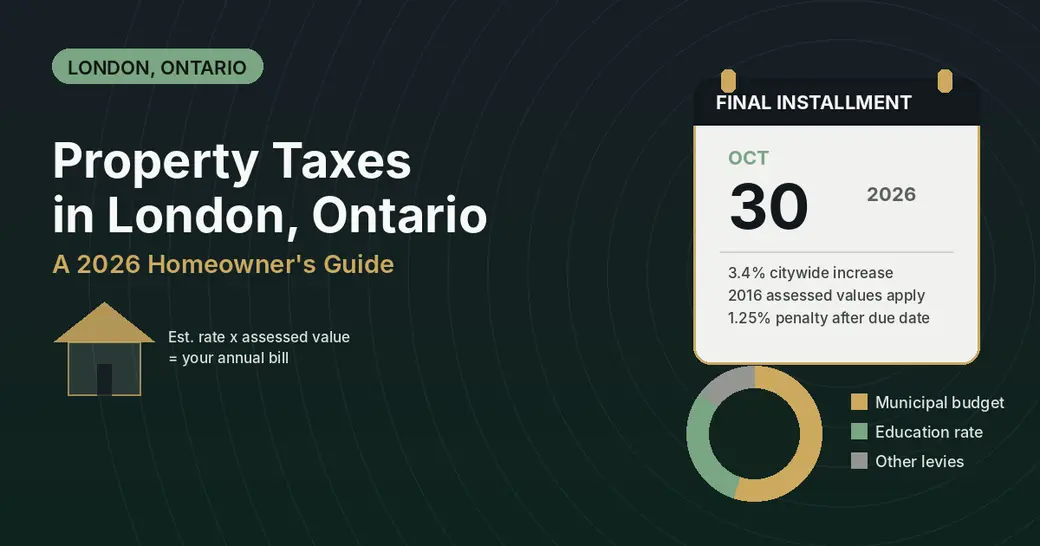
Property taxes in London, Ontario are calculated from three moving parts: the City's multi-year budget, the provincial education rate, and your MPAC assessment — and almost every homeowner I talk to is confused about at least one of them. As a REALTOR® with Century 21, First Canadian who's walked London buyers and sellers through closing day for years, I get asked about this constantly, especially right now: the final 2026 tax installment for most London homeowners is due October 30, just over a week away.
This guide breaks down how your bill is actually built, what changed in 2026, and what to do if the number on that notice caught you off guard.
Key Takeaways
- London property tax bills are set using two components: the City's budget-driven municipal rate and the province's education tax rate, applied to your MPAC assessed value.
- Council approved a 3.4% property tax increase for 2026, according to CTV News London — adding roughly $160 to the average household's annual bill.
- Final 2026 tax installments in London are due June 30, August 31, and October 30.
- Your assessed value is still based on January 1, 2016 current values; Ontario has postponed a province-wide reassessment since 2020.
- A higher assessment doesn't automatically mean a higher tax bill — it only matters relative to how other properties in your class were reassessed.
How Your London Property Tax Bill Is Calculated
The City of London sets your tax rate each year based on its multi-year budget, then applies that rate to your property's current value assessment from the Municipal Property Assessment Corporation (MPAC). A portion of every bill also goes toward the provincial education tax, which City Hall collects on the province's behalf but doesn't control.
This is the part that trips people up: your assessment and your tax bill aren't the same thing. If your home's assessed value went up more than the citywide average for your property class, your tax bill likely rose faster than the overall increase. If it went up less, you may have actually seen your taxes grow more slowly than your neighbours' — even though your home is worth more on paper.
One structural fact worth knowing if you're buying in London: assessed values are currently still based on a January 1, 2016 valuation date, fully phased in for the 2026 tax year. The Ontario government postponed the scheduled 2020 province-wide reassessment, and a 2023 regulation extended that postponement — so the number on your assessment notice reflects where your home's value stood relative to the rest of the province back in 2016, not today's market.
2026 Due Dates and Payment Options in London
London splits its tax year into interim and final billings:
- Interim bills were mailed January 31, 2026, with installments due February 27 and March 31. These are estimated from the prior year's taxes plus the average residential rate increase, since council hasn't set the current year's final rate yet.
- Council finalizes the actual tax rate each April. Whatever the difference is between your interim payments and the real number gets reconciled on your final bill.
- Final bills are due in three installments: June 30, August 31, and October 30, 2026 — so if you own a home in London, that last payment is coming up fast.
You can review full billing details, the Pre-Authorized Payment Plan, and current contact information on the City of London's property tax page. If you're on the City's Pre-Authorized Payment Plan, withdrawals happen on the last business day of each month from January through October, with none in November or December. There's no enrollment fee, but you need to be paid up to date to join, and supplementary tax bills aren't included — those are billed and paid separately.
Late payments carry a 1.25% penalty on the first day of default and again on the first of every following month, so if October 30 is going to be tight, it's worth calling the City's Tax Office before the due date rather than after.
Why Your London Property Tax Bill Changed in 2026
City council approved a 3.4% property tax increase for the 2026 budget year, according to CTV News London — adding about $160 to the average London household's annual bill once water and wastewater adjustments are included. That's a meaningfully smaller jump than 2024, when council adopted an 8.7% levy increase (about $286 for the average home) as part of the City's 2024–2027 multi-year budget.
If your personal increase looks bigger or smaller than that citywide average, the most common reason is your property's assessed value moving differently than the typical home in your class — not an error on your bill. If something still looks off, the Tax Office can walk through your specific notice with you, and MPAC can review your assessment if you think it doesn't reflect your property accurately.
First-Time Buyers in London: Don't Confuse This With Land Transfer Tax
I get this question from almost every first-time buyer I work with in London: property tax and land transfer tax are not the same thing, and you'll deal with both at different points.
- Land transfer tax is a one-time cost paid when you close on a home, based on the purchase price.
- Property tax is the ongoing annual bill tied to owning the home, which is what this guide is about.
If you're a first-time buyer in Ontario, you may qualify for a provincial land transfer tax refund of up to $4,000, which fully offsets the tax on homes above a set purchase-price threshold under the rates in effect when the refund was introduced. That refund only applies at closing — it has no effect on your annual property tax bill going forward.
Managing Your Property Tax Bill in London Going Forward
A few practical habits make property taxes easier to live with as a London homeowner:
- Enroll in Pre-Authorized Payments if predictable monthly withdrawals work better for your budget than lump installments.
- Budget for the April rate-setting adjustment. Because interim bills are estimates, your final bill can shift once council sets the real rate — plan for some movement rather than assuming your interim payment is your true monthly cost.
- Ask about relief programs if you're a senior or living with a disability. London has had a tax deferral program for qualifying low-income seniors and residents with disabilities; City Hall can confirm current eligibility.
- Request a tax certificate before closing if you're selling, since buyers' lawyers typically need one to confirm the account is current.
None of this replaces professional advice — for anything specific to your situation, from an assessment appeal to how a renovation might affect your assessed value, I'd always recommend speaking with a tax professional or reaching out to the City's Tax Office directly.
Frequently Asked Questions
When is the final property tax installment due in London, Ontario in 2026?
The last of three final installments is due October 30, 2026. The first two final installments were due June 30 and August 31, following interim installments in February and March.
Why did my property tax bill in London go up more than the City's announced increase?
The citywide percentage is an average. Your individual bill depends on how your property's MPAC assessment changed relative to other properties in your class, not just the overall budget increase.
Are London, Ontario property taxes based on current home values?
No. Assessments are currently based on a January 1, 2016 valuation date. Ontario has postponed the scheduled province-wide reassessment since 2020, so 2026 bills still use those 2016-based values.
Is land transfer tax the same as property tax in London, Ontario?
No. Land transfer tax is a one-time charge paid when you buy a home. Property tax is the recurring annual bill from the City. First-time buyers may qualify for a provincial land transfer tax refund, which doesn't affect ongoing property taxes.
What happens if I miss a property tax installment in London?
The City applies a 1.25% penalty on the first day of default and again on the first day of each following month the balance remains unpaid. If you're worried about an upcoming due date, contact the Tax Office before it passes.
The Bottom Line
Property taxes can feel like a black box, but the mechanics in London are straightforward once you see the pieces: your MPAC assessment, the City's budget-driven rate, and the provincial education portion. With the October 30 installment coming up and a 3.4% citywide increase built into 2026 bills, now's a good time to double-check your account is current and your payment plan fits your budget.
Whether you're budgeting for your first home purchase in London or trying to make sense of this year's bill, I'm happy to talk through how property taxes factor into your next move. You can reach me directly at (647) 883-7135, browse current listings and neighbourhood guides at 519propertyfinder.com, or schedule a free consultation and we'll go through it together.
Categories
- All Blogs (81)
- Compare Neighbourhoods (4)
- Downsizing & Upsizing (2)
- First-Time Home Buyers (6)
- Home Selling Tips (1)
- Investment Properties (2)
- London Ontario Real Estate (6)
- Market Updates (11)
- Middlesex (15)
- Neighbourhood Guides (15)
- New Construction (5)
- Oxford County Real Estate (13)
- Property Taxes & Closing Costs (4)
- Relocation Guides (2)
- Rural & Small Town Living (10)
- Schools & Family Neighbourhoods (6)
- Seasonal (3)
Recent Posts