Tillsonburg vs. Woodstock, Ontario: Where Should You Buy in 2026?
If you're weighing Tillsonburg vs Woodstock Ontario for your next home, the short answer is this: Woodstock gives you more size, a direct seat on Highway 401, and a bigger range of housing stock, while Tillsonburg gives you a smaller-town feel, faster population growth, and a real estate board benchmark price that still runs slightly below where comparable homes sell in London. As a REALTOR® with Century 21, First Canadian who works across Oxford County every week, I get this question constantly from buyers cross-shopping both towns, so I pulled the actual numbers together in one place.
Both communities sit inside the same real estate board's coverage area, both are growing, and both are genuinely good options — but they serve different priorities. Here's what the data says, and how I'd think about the choice if I were sitting across the table from you.
Key Takeaways
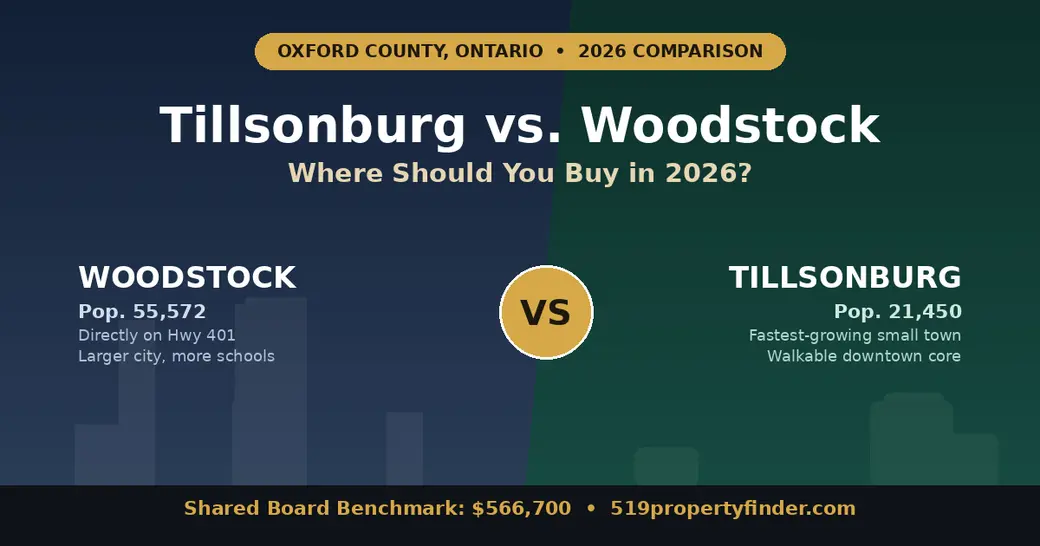
- Woodstock's 2025 population estimate is 55,572, more than double Tillsonburg's 21,450, according to Oxford County's own community profile.
- Tillsonburg grew 17.3% between 2016 and 2021 — the third-fastest growth rate of any community in Canada, per Statistics Canada's 2021 Census — and the county's own updated 2025 estimates show that growth has continued.
- The Woodstock Ingersoll Tillsonburg & Area Association of REALTORS® reported a composite MLS® Home Price Index benchmark of $566,700 in September 2026, down 5.1% year-over-year, with an average sale price of $636,664 across the shared board area.
- Woodstock sits directly on Highway 401; Tillsonburg is a short drive south via Highway 19, with a T:GO inter-community bus connecting it to Woodstock, Ingersoll, Norwich, and London.
- Woodstock has three public and Catholic secondary schools; Tillsonburg has one, Glendale High School, reflecting the size difference between the two communities.
Size and Population: A Real Difference in Scale
The biggest distinction between these two towns isn't price — it's size. Woodstock's population sat at an estimated 55,572 as of 2025, according to Oxford County's own community profile, making it the largest community in Oxford County outside of London's immediate orbit. Tillsonburg, by comparison, was estimated at 21,450 residents over the same period — well under half of Woodstock's size, within the same county dataset.
That gap matters for day-to-day life. Woodstock functions like a self-contained small city, with its own hospital, a full range of big-box and independent retail, and a downtown core built around Dundas Street. Tillsonburg feels more like a classic small Ontario town, where Broadway Street's shops and the Station Arts Centre's restored 1800s train stations anchor the social core.
Growth tells a different story than size, though. Tillsonburg's population grew 17.3% between 2016 and 2021, a rate Statistics Canada's 2021 Census ranked as the third-fastest of any community in the entire country, and Oxford County's updated 2025 estimates show that momentum has continued. Woodstock has also continued adding residents, but off a larger base and at a steadier, less dramatic percentage pace. If you're buying with an eye on which town is changing faster in relative terms, Tillsonburg is the one in the middle of a bigger shift.
Home Prices in Woodstock and Tillsonburg Right Now
Here's something buyers comparing these two towns are often surprised to learn: Woodstock and Tillsonburg are tracked by the same real estate board, the Woodstock Ingersoll Tillsonburg & Area Association of REALTORS®, which reports pricing across its full coverage area rather than breaking out each town separately. As of September 2026, the board's composite MLS® Home Price Index benchmark price was $566,700, down 5.1% from a year earlier, while the average price of homes actually sold came in at $636,664, down a slight 0.6% year-over-year. Sales activity was up 4.1% from September 2025, while new listings fell 8.5%, which tells me buyers willing to move quickly this fall have a bit less competition than they did over the summer.
Within that shared board number, I typically see Woodstock's detached homes carry a modest premium over comparable Tillsonburg properties, largely because Woodstock's housing stock includes more newer subdivisions built over the past decade, while Tillsonburg's core neighbourhoods lean slightly older. That's a generalization based on what I see listing-to-listing, not a board-published split, so if price point is your deciding factor, I'd rather pull current comparables in your specific size and style range than quote you an average that may not reflect what's actually available right now.
Jobs and Economy: What's Driving Each Market
Woodstock's economy has a well-known anchor in Toyota's local assembly plant, which continues to support a broad supply chain of manufacturing and logistics employers along the Highway 401 corridor between London and Kitchener-Waterloo. That kind of large, established employer gives Woodstock a steady base of local jobs that's attracted families and renters alike.
Tillsonburg has taken a different path to the same result: industrial growth concentrated in its Van Norman Innovation Park, where Phase 1 is fully built out and newer projects like Armtec's manufacturing facility are adding roughly 100 local jobs. It's a smaller economy in absolute terms, but it's one that's expanding from a lower base, which is part of why Tillsonburg's population growth has outpaced Woodstock's in percentage terms.
Getting Around: Commute and Transit
Location on the map is one of the clearest practical differences between these two towns. Woodstock sits directly on Highway 401, with Highways 401 and 403 meeting nearby in Oxford County, according to Tourism Oxford — which makes a Woodstock home a straightforward highway commute toward London, Kitchener-Waterloo, or even the GTA.
Tillsonburg sits a bit further south, reached primarily via Highway 19, and doesn't have the same direct 401 frontage. For residents without a vehicle, or anyone who wants a transit backup, the T:GO inter-community bus connects Tillsonburg to Woodstock, Ingersoll, Norwich, Otterville, and London, per Tourism Oxford's own transportation guide. Woodstock also runs its own local city bus service on weekdays and Saturdays. If a direct highway commute matters more to you than anything else on this list, that alone can tip the decision toward Woodstock.
Schools in Woodstock and Tillsonburg
Both towns fall within the Thames Valley District School Board for public education and the London District Catholic School Board for Catholic education, so families moving between them stay inside the same two boards. The difference is in scale and choice. Woodstock's secondary options include Woodstock Collegiate Institute and Huron Park Secondary School on the public side and St. Mary's Catholic High School on the Catholic side, plus French-language options, according to the City of Woodstock's own schools page. Tillsonburg has one secondary school, Glendale High School, serving the entire town, per the Town of Tillsonburg's website.
Neither setup is better on its face — it depends on whether you're looking for a wider range of programs and school choice, which Woodstock's larger population supports, or a single, tight-knit secondary school community, which is what Tillsonburg offers by virtue of its size.
Downtown Character and Everyday Life
This is where the two towns feel most different in person, not just on paper. Woodstock's downtown centres on Dundas Street, home to the Oxford County Museum, housed in the 1851-52 former town hall — a National Historic Site of Canada protected by an Ontario Heritage Trust easement. It's a downtown with real civic weight to it, built when Woodstock was already an established regional centre.
Tillsonburg's Broadway Street has a different texture: independent shops like Betty's Marketplace and Cherished Pieces, the restored rail-era buildings of the Station Arts Centre, and Lake Lisgar Waterpark a short walk from the core, with its waterslide and splash pad drawing families all summer. It's a more intimate, walkable downtown scaled to a smaller town. In my experience showing both markets, buyers who gravitate toward Tillsonburg often mention wanting exactly that — a downtown they can walk across in ten minutes.
Which Oxford County Market Is Right for You?
If I had to boil this down to one practical filter: choose Woodstock if a direct Highway 401 commute, a wider range of schools and housing stock, or big-city conveniences in a smaller package matter most to you. Choose Tillsonburg if you want a close-knit small-town feel, you're comfortable with a slightly longer or transit-assisted commute, and you want to be part of a community that's still in an earlier, faster stage of its growth curve. Both sit inside the same real estate board's benchmark pricing, so neither is dramatically more or less affordable on paper — the real difference is lifestyle fit.
Frequently Asked Questions
Is Tillsonburg or Woodstock better for commuters to London, Ontario?
Woodstock has the edge for commuters because it sits directly on Highway 401. Tillsonburg is reachable via Highway 19 or the T:GO inter-community bus, which adds time compared to a direct highway drive from Woodstock.
Are home prices different between Tillsonburg and Woodstock?
Both towns are tracked by the same real estate board, the Woodstock Ingersoll Tillsonburg & Area Association of REALTORS®, which reported a composite benchmark price of $566,700 in September 2026 across its coverage area. Individual price points vary by property and neighbourhood within both towns.
Which town is growing faster, Tillsonburg or Woodstock?
Tillsonburg grew 17.3% between 2016 and 2021, the third-fastest rate in Canada, according to Statistics Canada, and Oxford County's 2025 estimates show that pace has continued. Woodstock's growth has been steadier and more gradual, though it remains the much larger community at an estimated 55,572 residents in 2025, per Oxford County.
Do Tillsonburg and Woodstock share the same school boards?
Yes. Both fall under the Thames Valley District School Board for public education and the London District Catholic School Board for Catholic education. Woodstock has more secondary school options; Tillsonburg's secondary students attend Glendale High School.
What's the biggest lifestyle difference between the two towns?
Woodstock offers a larger, more self-contained small city with a historic downtown on Dundas Street. Tillsonburg offers a tighter, more walkable downtown on Broadway Street with Lake Lisgar Waterpark nearby, and a stronger sense of small-town scale.
Ready to Compare Tillsonburg and Woodstock in Person?
Numbers only tell part of the story — the rest comes from walking both downtowns, touring a few streets in each town, and figuring out which one actually feels right for how you want to live. As a Century 21, First Canadian REALTOR® who works across Oxford County, I can put together a side-by-side tour of both markets based on your budget, commute needs, and the kind of neighbourhood you're picturing. Schedule a free consultation at 519propertyfinder.com/contact or call me directly at (647) 883-7135, and let's figure out whether Tillsonburg or Woodstock is the better fit for you.
Categories
- All Blogs (79)
- Compare Neighbourhoods (4)
- Downsizing & Upsizing (2)
- First-Time Home Buyers (6)
- Home Selling Tips (1)
- Investment Properties (2)
- London Ontario Real Estate (5)
- Market Updates (11)
- Middlesex (15)
- Neighbourhood Guides (15)
- New Construction (5)
- Oxford County Real Estate (12)
- Property Taxes & Closing Costs (3)
- Relocation Guides (2)
- Rural & Small Town Living (9)
- Schools & Family Neighbourhoods (6)
- Seasonal (3)
Recent Posts