Winter Home Maintenance Checklist for Middlesex County, Ontario Homeowners (2026)
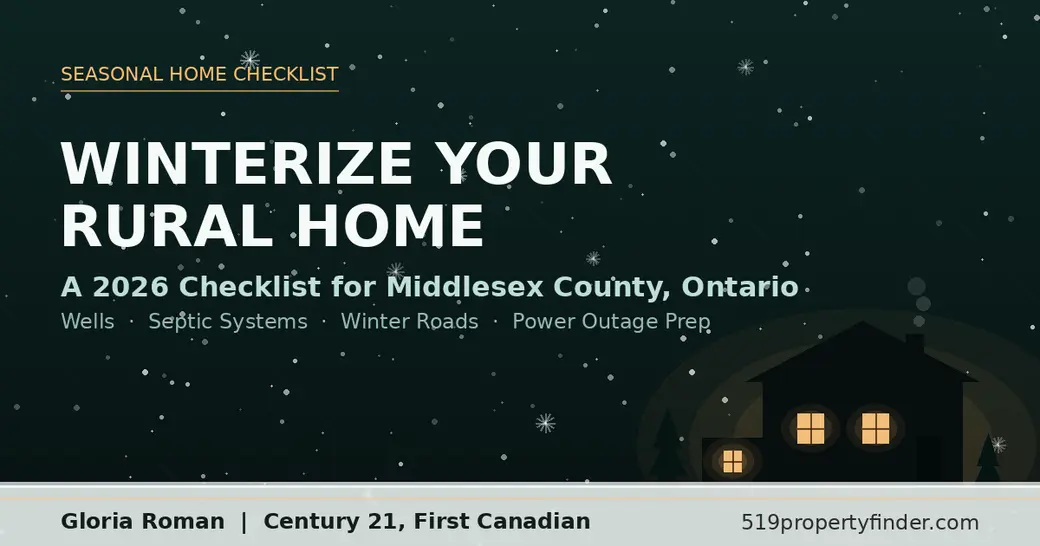
Winter in Middlesex County asks more of a home than winter in the city does. If you own a property on a private well and septic system in Middlesex Centre, Strathroy-Caradoc, Thames Centre, North Middlesex, Southwest Middlesex, Lucan Biddulph or Adelaide Metcalfe, you're managing your own water supply, your own wastewater treatment, and a longer wait for the plow than homeowners inside London's city limits. I'm Gloria Roman, a REALTOR® with Century 21, First Canadian who works with buyers and sellers across these rural Middlesex County communities every week, and this is the winter maintenance checklist I walk my own clients through before the snow arrives: your well, your septic system, your driveway and your power supply.
Key Takeaways
- Private wells should be tested regularly and retested after flooding, heavy rain or snowmelt, per the Middlesex-London Health Unit — not just once a year.
- Septic tanks generally need pumping every three to five years, and vehicles should never drive over a leaching bed, even when it's buried under snow.
- Rural side roads are classified as lower-priority routes under provincial winter maintenance standards, so expect a longer wait for the plow than on arterial roads — and your driveway is your own responsibility under local by-laws.
- The County of Middlesex recommends every household keep a 72-hour emergency kit on hand for winter power outages.
Protect Your Private Well Before the Deep Freeze
If your Middlesex County property draws its water from a private well, winter adds a layer of risk that a municipal water hookup doesn't carry. The Middlesex-London Health Unit recommends testing well water regularly, because water quality can shift throughout the year even when the water still looks clear and tastes fine. It specifically advises retesting after heavy rain, flooding or snowmelt, after any well repairs, and after construction near the well — all situations a Middlesex County winter and spring thaw can bring. Testing for E. coli and total coliform bacteria is free for private residences through the London Public Health Laboratory, with drop-off locations that include the Health Unit's London and Strathroy offices and several township offices across the county.
Freezing is the other half of the equation. Health Canada's guidance on well safety during emergencies recommends insulating and heating exposed water lines, burying them below the local frost line, or routing them through a heated space such as a pump house. If you're worried a line might freeze during a cold stretch, leaving the tap on that line dripping can keep water moving enough to prevent ice from forming solid. And if a flood or power outage does hit your well, don't simply flip the pump back on afterward — have a licensed well contractor inspect the well and its wiring first, since wet or damaged equipment can pose a shock risk.
Don't Forget the Septic System
Most homes outside London's municipal sewer boundary — including a large share of the properties I show across Middlesex Centre, Strathroy-Caradoc and the county's smaller communities — rely on a private septic system rather than municipal wastewater service. Septic systems need a lighter touch than a well, but winter is exactly the wrong time to ignore them. Indigenous Services Canada's septic guidance recommends having the tank pumped every three to five years, or sooner if sludge has filled roughly a third of the tank, and keeping harmful products such as paints, solvents and medications out of the system since they kill the bacteria that break waste down.
The one rule that matters most once the snow is on the ground: never drive a vehicle, snowmobile or heavy equipment over your leaching bed, even when it's buried under a foot of snow. The weight can crush distribution pipes or compact the soil around them, and a problem you create in January may not show itself until spring thaw. If you're not sure exactly where your leaching bed sits on the property, that's worth confirming with your septic service provider before winter, not after.
What to Expect From Winter Road Plowing in a Rural Township
One of the biggest adjustments for buyers moving from the city into rural Middlesex County is how differently winter roads get treated. Under the provincial winter maintenance standards that Middlesex Centre and the county's other lower-tier municipalities follow, roads are sorted into five classes. Classes 1 through 3 are the priority arterial and collector routes, and Middlesex Centre's own winter road guidance notes it can take 8 to 12 hours to clear those after snow stops falling. Classes 4 and 5 — the local rural side roads and cul-de-sacs many Middlesex County properties sit on — are plowed only after the priority routes are done, with a roughly 24-hour target for all municipal roads and longer during a heavier or continuous snowfall.
Your driveway is a separate matter entirely. Middlesex Centre's guidance is direct: plows push snow onto the boulevard, your driveway apron counts as part of that boulevard, and the municipality doesn't have the resources to clear driveways. Clearing your own driveway and walkway is a property owner's responsibility under local property standards and right-of-way by-laws. A small trick that helps: when you shovel the end of your driveway, pile the snow on the downstream side (the direction the plow is travelling), since that reduces how much windrow the next plow pass leaves behind. Exact winter maintenance policies and response windows vary by township, so if you're buying in Strathroy-Caradoc, Thames Centre, North Middlesex, Southwest Middlesex, Lucan Biddulph or Adelaide Metcalfe specifically, it's worth checking that municipality's own winter operations page rather than assuming Middlesex Centre's numbers apply everywhere.
Power Outage Preparedness for a Rural Property
Rural Middlesex County properties tend to feel a power outage more than a home in a London subdivision does, since an outage can also mean no pressure to your well pump and no power to a septic system's pump chamber, if it has one. The County of Middlesex's own winter preparedness guidance recommends every household keep a 72-hour emergency kit on hand: non-perishable food and four litres of water per person per day, a manual can opener, flashlight, battery or crank radio, medications and a basic first-aid kit. The county's guidance is blunt about generator safety — never run a generator, barbecue, camp stove or any other fuel-burning engine indoors or in an attached garage, because of the risk of carbon monoxide buildup, and store liquid fuel or propane in a shed or detached garage rather than inside the house.
A few other details from the county's guidance are easy to forget until you need them: a closed fridge keeps food cold for roughly 4 to 6 hours during an outage, and a closed freezer keeps food frozen for about 24 to 36 hours; leave one light switched on inside and one outside so you know the moment power is restored; and keep your vehicle's gas tank more than half full through the winter months in case you need to leave home or run it briefly for warmth. For outage updates, the county points residents to 211 or to your utility's own outage map — Hydro One serves most of rural Middlesex County.
A Note for Buyers and Sellers Touring Rural Properties This Winter
If you're house-hunting in Middlesex County this winter, a showing is a good moment to ask the questions a spring viewing can hide. How old is the well, and when was it last tested? When was the septic tank last pumped, and does the seller know where the leaching bed sits? Is there a generator hookup already in place, and what's the township's typical plow response time on that specific road? Sellers who can answer those questions with documentation — a recent well test, septic pumping records, a generator transfer switch — tend to put buyers at ease faster than a listing description ever will. It's one of the reasons I walk every rural buyer through this exact list before we tour a property, and why I encourage my sellers in Middlesex Centre, Strathroy-Caradoc and the surrounding townships to have this paperwork ready before the first showing.
Frequently Asked Questions About Winterizing a Rural Middlesex County Property
Q: How often should I test my well water in Middlesex County?
The Middlesex-London Health Unit recommends testing regularly rather than on a fixed annual schedule, and specifically retesting after heavy rain, flooding, snowmelt, well repairs or nearby construction. E. coli and coliform testing is free for private residences through the London Public Health Laboratory.
Q: How often does a septic tank need to be pumped?
Indigenous Services Canada's guidance recommends pumping every three to five years, or sooner if roughly a third of the tank has filled with sludge. A licensed professional should handle the pumping and disposal.
Q: Who is responsible for clearing snow from a rural driveway in Middlesex County?
The property owner is. Municipalities such as Middlesex Centre plow the roads and push snow onto the boulevard, but clearing your own driveway and walkway falls to you under local property standards and right-of-way by-laws.
Q: Should I buy a generator for a rural home in Middlesex County?
Many rural homeowners do, given the longer outage exposure and plow wait times compared to London. If you do, never run it indoors or in an attached garage because of carbon monoxide risk, and store fuel separately from the house, per the County of Middlesex's winter preparedness guidance.
Q: What should be in a winter emergency kit for a rural property?
The County of Middlesex recommends a 72-hour supply of non-perishable food, four litres of water per person per day, a manual can opener, flashlight with spare batteries, a battery or crank radio, medications, a basic first-aid kit and candles in sturdy holders.
Ready to Buy or Sell a Rural Middlesex County Property?
Whether you're weighing a move into Middlesex Centre, Strathroy-Caradoc, Thames Centre, North Middlesex, Southwest Middlesex, Lucan Biddulph or Adelaide Metcalfe, or you already own a rural property and have questions about what buyers will ask this winter, I'm happy to help. As a REALTOR® with Century 21, First Canadian who works across London and the surrounding Middlesex County communities, I can walk you through what a well, septic system and winter road access actually mean for a property's value and livability. Schedule a free consultation at 519propertyfinder.com/contact, or reach me directly at (647) 883-7135 or romanofrealestate@gmail.com.
Categories
- All Blogs (110)
- Compare Neighbourhoods (5)
- Downsizing & Upsizing (2)
- First-Time Home Buyers (8)
- Home Selling Tips (2)
- Investment Properties (3)
- London Ontario Real Estate (21)
- Market Updates (14)
- Middlesex (24)
- Neighbourhood Guides (22)
- New Construction (7)
- Oxford County Real Estate (19)
- Property Taxes & Closing Costs (4)
- Relocation Guides (2)
- Rural & Small Town Living (16)
- Schools & Family Neighbourhoods (8)
- Seasonal (5)
Recent Posts