Buying Acreage Near London, Ontario: A 2026 Guide
If you're picturing a few acres, a workshop, and room to breathe, you're not alone. Buying acreage near London, Ontario means trading a city lot for one of the eight rural municipalities that ring the city — Middlesex Centre, Strathroy-Caradoc, Thames Centre, North Middlesex, Southwest Middlesex, Lucan Biddulph, Adelaide Metcalfe, or the Village of Newbury. I'm Gloria Roman, a REALTOR® with Century 21, First Canadian, and I spend a lot of my time out on gravel roads with buyers who want exactly this. Country property is its own kind of purchase, with its own due-diligence list, and I'd rather walk you through it now than have you discover it mid-closing.
Key Takeaways
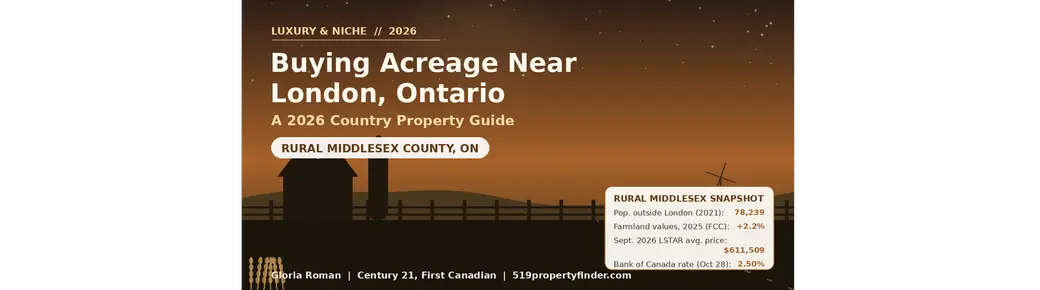
- Rural Middlesex County is made up of eight lower-tier municipalities, with a combined 2021 population of 78,239 people outside the City of London, according to Statistics Canada's 2021 Census.
- Almost every country property outside a hamlet's serviced core runs on a private well and septic system — the Middlesex-London Health Unit recommends testing well water regularly, with free E. coli and coliform testing available for private residences.
- If there's an active livestock operation nearby, Ontario's Minimum Distance Separation (MDS) formulae may affect what you can build and where — worth checking with the local municipality before you fall in love with a property.
- Ontario farmland values rose 2.2% in 2025, a slower pace than prior years, according to Farm Credit Canada — useful context if you're weighing land as part of the purchase.
- Splitting a rural lot into two (a "severance") is a municipal planning process, not something you can assume will be approved — budget time and a possible consultant's fee if that's part of your plan.
What "Country Property" Actually Means Around London
Not every rural listing is the same animal. Around London, you'll see three broad types: a rural residential lot carved off a farm decades ago (often an acre or two with a house and maybe a detached shop), a hobby farm (anywhere from five to forty-some acres, usually with some combination of pasture, a barn, and outbuildings, but not a full commercial operation), and working farmland with a residence attached, where the land itself is the asset and the house is almost secondary.
Which one you're looking at changes everything — your financing options, your insurance, even how the municipality will treat future building permits. I always ask buyers early: are you buying a lifestyle, or are you buying a business? Most of my clients want the former — space for a large garden, a couple of horses, or just genuine quiet — without taking on the water and heavy machinery that commercial operations in Thames Centre and North Middlesex run with.
Water, Septic, and the Realities of Rural Services
The single biggest adjustment for buyers moving out of London is utilities. Outside the serviced cores of villages like Ilderton, Komoka, or Thorndale, homes run on a private well and a septic system — there's no municipal water line or sewer hookup to fall back on.
The Middlesex-London Health Unit doesn't set a fixed testing schedule, but it recommends testing well water regularly, and especially after heavy rain, flooding, snowmelt, well repairs, or construction nearby. The health unit offers free E. coli and total coliform testing for private residences through the London Public Health Laboratory, with rural drop-off points at several township offices and libraries — you can also sign up for an annual email reminder through the health unit directly. A water test at or just before closing should be part of every rural offer; a chemical or bacteriological problem is far easier to negotiate before you own it than after.
Septic systems are the other half of that equation. A septic inspection — checking the tank, the bed, and how the system is handling the property's actual usage — belongs in your conditions right alongside a standard home inspection. I've seen deals renegotiated over a septic bed that needed replacing, and I'd rather my buyers know that number going in.
Understanding Minimum Distance Separation Before You Buy
If the property you love sits near an active barn, you'll want to understand Ontario's Minimum Distance Separation (MDS) formulae before you get too attached. MDS sets the minimum setback between livestock barns or manure storages and new development — it exists, per the province, to minimize land use conflicts and nuisance complaints related to odour.
There are two versions that matter in opposite directions: MDS I calculates the setback a new home or addition needs from an existing barn, and MDS II calculates the setback a new or expanding livestock facility needs from existing homes and lot lines. The actual distance depends on the type and size of the operation, the manure storage system, and the lot configuration — there's no single number, which is exactly why it's worth a call to the local municipality (Middlesex Centre, Thames Centre, North Middlesex, and the rest each administer this through their planning departments) before you build or add on near a working farm. It's also worth asking, politely, whether any nearby operation has filed for an expansion — that's the kind of local knowledge your REALTOR® should be chasing down for you.
What's Driving Demand for Acreage Near London Right Now
Rural demand around London doesn't move in isolation from the city market — the same buyers often cross-shop both. Regionally, the London and St. Thomas Association of REALTORS® reported 561 home sales in September 2026, up 5.3% year over year, with an average sale price of $611,509 and 5.9 months of inventory — a market that's still giving buyers more room to negotiate than it was a couple of years ago.
Borrowing costs factor in too. The Bank of Canada raised its policy interest rate to 2.50% on October 28, 2026, its first increase after holding steady at 2.25% since September 2025. If you're financing a rural purchase — especially one where a lender wants a larger down payment for acreage or an older well-and-septic home — that's worth building into your pre-approval conversation now rather than later.
And if land value itself is part of your decision, Farm Credit Canada reported that Ontario farmland values rose 2.2% in 2025, a slower pace of growth than the province saw in prior years, even as the national average climbed 9.3%. That's useful context whether you're buying ten acres with the house or just want to know what the dirt underneath it is doing.
On the population side, Middlesex County outside London counted 78,239 residents in the 2021 Census, and the County's own long-range forecasting projects that number could reach somewhere between roughly 96,300 and 115,000 by 2046, depending on growth scenario. That's steady, not explosive, growth — which tends to keep rural inventory from swinging wildly in either direction.
Severances, New Builds, and What You Can (and Can't) Do With the Land
A lot of buyers ask me whether they can split a larger rural parcel in two down the road — maybe to build a second home for a parent, or to sell off a portion later. The honest answer: maybe, but it's a municipal planning application (a "consent" or severance), not a given. Each of the eight lower-tier municipalities reviews these individually, weighing things like lot frontage, access, services, and agricultural land policy, and decisions can take months and sometimes involve a planning consultant's fee. If a future severance matters to your purchase, it needs to be a question you ask the municipality before you make an offer contingent on it — not an assumption you build your plans around.
The same goes for new construction or major additions on rural lots: septic capacity, well setbacks, MDS (if there's livestock nearby), and the municipality's own zoning all come into play before a building permit is issued. None of this should scare you off country living — it just means your due diligence list is longer than it would be for a townhouse in London, and it's exactly the kind of list I walk every rural buyer through before we write an offer.
Frequently Asked Questions About Buying Acreage Near London
Do I need a special mortgage to buy a rural property with acreage?
Not always, but lenders often treat properties with significant acreage, outbuildings, or working farm components differently than a standard residential mortgage, sometimes requiring a larger down payment. Talk to your mortgage professional early about how they'll classify the specific property you're considering.
How do I know if a well and septic system are in good condition before buying?
Get a current water test — free E. coli and coliform testing is available through the Middlesex-London Health Unit for private residences — and have a qualified inspector assess the septic tank and bed as part of your home inspection conditions.
What is Minimum Distance Separation and does it affect my purchase?
MDS is a provincial formula setting minimum distances between livestock operations and new development, intended to reduce odour-related conflicts. If a property is near an active farm, check with the local municipality's planning department before planning any new construction.
Can I split a rural property into two lots later?
Possibly, through a municipal severance (consent) application, but it's never guaranteed. Each municipality evaluates frontage, access, services, and agricultural policy on a case-by-case basis, so confirm feasibility with the municipality before counting on it.
Is now a good time to buy country property near London?
With London-area home sales up 5.3% year over year in September 2026 but still sitting at 5.9 months of inventory, buyers currently have more room to negotiate than in a tighter market. Financing costs shifted slightly with the Bank of Canada's October 28, 2026 rate increase to 2.50%, so it's worth locking in a current pre-approval rather than guessing at future rates.
Ready to Explore Country Living Near London?
Country property near London rewards buyers who do their homework — on water, septic, setbacks, and what the municipality will actually allow — and it's exactly the kind of purchase where local, on-the-ground guidance pays for itself. I've walked clients through hobby farms in Middlesex Centre, rural residential lots in Thames Centre, and everything in between, and I'd be glad to do the same for you.
If you're ready to start looking at acreage or country property around London, call me, Gloria Roman, at (647) 883-7135, or visit 519propertyfinder.com to schedule a free consultation. Let's find the right piece of land for how you actually want to live.
Categories
- All Blogs (93)
- Compare Neighbourhoods (4)
- Downsizing & Upsizing (2)
- First-Time Home Buyers (7)
- Home Selling Tips (2)
- Investment Properties (3)
- London Ontario Real Estate (11)
- Market Updates (12)
- Middlesex (20)
- Neighbourhood Guides (16)
- New Construction (6)
- Oxford County Real Estate (16)
- Property Taxes & Closing Costs (4)
- Relocation Guides (2)
- Rural & Small Town Living (14)
- Schools & Family Neighbourhoods (6)
- Seasonal (3)
Recent Posts