Living in Fanshawe, London Ontario: A 2026 Guide
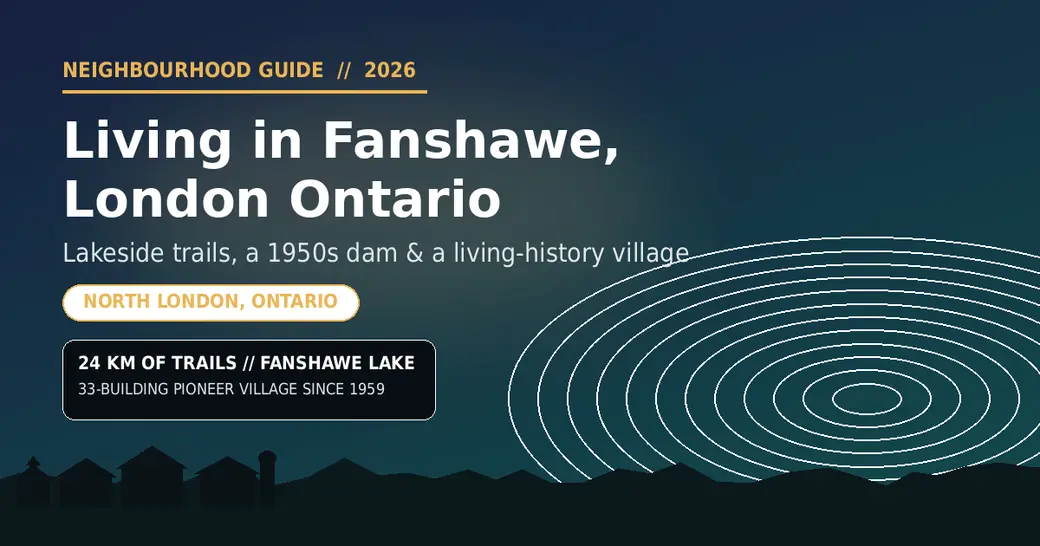
If you're searching for what it's like living in Fanshawe, London Ontario, here's the short answer: you get a quiet, established North London address built around a reservoir, 24 kilometres of trails, and one of the region's best-known living history museums — all within a 15-minute drive of downtown. I'm Gloria Roman, a REALTOR® with Century 21, First Canadian, and Fanshawe is one of the North London pockets I get the most questions about, usually from buyers who've driven past the lake on Fanshawe Park Road and want to know what the surrounding streets are actually like. This guide covers the neighbourhood's history, the housing stock, what's nearby, and what to know before you start touring homes.
Key Takeaways
- Fanshawe takes its name from a 19th-century hamlet that once stood where the City of London now sits, and that same name carries through to Fanshawe College, Fanshawe Dam, Fanshawe Lake, and Fanshawe Conservation Area.
- Fanshawe Conservation Area, managed by the Upper Thames River Conservation Authority (UTRCA), offers 24 km of hiking trails — including a 20 km loop around Fanshawe Lake — plus camping, canoe and kayak rentals, and fishing.
- Fanshawe Pioneer Village, a 46-acre open-air museum with 33 historic structures, has operated on the conservation lands since 1959 and holds more than 25,000 donated artefacts.
- Fanshawe College's main London campus — 100 acres and 23 buildings — was built in the former hamlet of Fanshawe, which is why the college carries the same name as the lake and the neighbourhood around it.
- London's overall resale market stayed active through September 2026, with 561 home sales reported by the London and St. Thomas Association of REALTORS® (LSTAR), up 5.3% from a year earlier.
What Is Fanshawe, and Why Does Everything Here Share Its Name?
Most buyers assume Fanshawe College, Fanshawe Lake, and the Fanshawe neighbourhood are just coincidentally named. They're not. Fanshawe was originally a small hamlet in what's now northeast London, and when the Upper Thames River Conservation Authority built a flood-control dam on the North Thames River in the early 1950s, it took the hamlet's name. Fanshawe College's main London campus — a 100-acre site with 23 buildings — was later built on that same former hamlet site, which is why the college, the lake, the dam, and the surrounding residential pockets all carry the Fanshawe name today.
The dam itself is a serious piece of infrastructure: its crest runs 625 metres and it stands 30.5 metres high, built between 1950 and 1952 at a cost of roughly $5 million after repeated flooding on the Thames River. It still generates enough hydroelectric power for about 400 households, and it created the reservoir known today as Fanshawe Lake. For a North London buyer, the practical upshot is this: the neighbourhood sits adjacent to one of the largest green and blue spaces in the city, something very few other London addresses can claim.
Living in Fanshawe Means Easy Access to 24 Kilometres of Trails
If you spend time outdoors, this is the headline reason buyers give me for choosing the area. Fanshawe Conservation Area, run by the UTRCA, offers 24 kilometres of hiking trails, including a 20-kilometre Lake Trail that loops the full perimeter of Fanshawe Lake and is also popular with mountain bikers. The conservation area runs canoe and kayak rentals on the lake, maintains a fishing guide for anglers, and operates seasonal and short-stay camping — though the UTRCA recommends booking ahead, since the campground fills up from late June through early September.
The Watson Porter Pavilion, also on the conservation lands, is a waterfront event venue with shade trees and open greenspace that's booked regularly for weddings and community gatherings. In my experience helping buyers in this part of the city, having that kind of amenity a short drive (and in some streets, a short walk) from home is a genuine lifestyle draw, not just a nice-to-have — it's the difference between planning a weekend outdoor trip and just walking out your door.
Fanshawe Pioneer Village: A Living History Museum Minutes From Home
Tucked inside the same conservation lands is Fanshawe Pioneer Village, an open-air heritage museum that's been operating since 1959. It's not a small roadside attraction — the site holds 33 original and replica historic structures across 46 acres, arranged into four historical clusters that recreate rural life in the former Middlesex County townships between 1820 and 1920, along with London's own early development up to 1840. The village is owned and run by the London and Middlesex Heritage Museum, a registered charity, with support from the City of London, the UTRCA, Thames Centre, and Middlesex Centre. Its collection runs past 25,000 donated artefacts, mostly from London and Middlesex County families, and the village hosts historically themed public events throughout the year.
For families house-hunting in Fanshawe, this matters beyond the novelty factor. It's a genuinely active community institution, not a dormant landmark, and it gives the neighbourhood a sense of local identity that newer London subdivisions haven't had time to build yet.
The Homes You'll Find When House-Hunting in Fanshawe, London Ontario
Fanshawe's residential streets sit mostly east and south of the lake, within reach of Fanshawe Park Road East and the Clarke Road corridor. The housing stock here reflects a neighbourhood built up over several decades rather than a single development cycle: expect a mix of single-family detached homes on established, tree-lined lots, along with townhomes and low-rise condominiums closer to the main arterial roads. Because the area developed in stages, lot sizes and architectural styles vary more block to block than you'd see in a brand-new subdivision — which is part of the appeal for buyers who want mature trees and some separation between homes without leaving the city.
Proximity to Fanshawe College also shapes the rental and resale market here. Investors and buyers looking at income potential ask about this area specifically because of consistent student and staff housing demand tied to the campus, though I'd always recommend running the numbers on a specific property with me rather than assuming any one-size-fits-all return — every street and property type performs differently.
Schools and Getting Around in North London's Fanshawe Area
Like the rest of London, the Fanshawe area falls within the boundaries of both the Thames Valley District School Board and the London District Catholic School Board, which operate the public and Catholic elementary and secondary schools serving North London. Because catchment boundaries are set and occasionally adjusted by the boards themselves, I always recommend confirming the exact school your prospective address is zoned for directly with TVDSB or LDCSB before making an offer — it's a five-minute call that can save a lot of second-guessing later.
For commuting, Clarke Road and Fanshawe Park Road East connect the neighbourhood to Highway 401 and the rest of the city without cutting through downtown traffic, and London Transit routes run along both corridors. If your daily routine includes Fanshawe College itself, you're looking at one of the shortest commutes in the city.
What's Happening in the London, Ontario Housing Market Right Now
Neighbourhood-specific sales data for a pocket as small as Fanshawe isn't something I'd present as a hard public statistic — if you want a real sense of what's selling and for how much on a specific street, that's exactly the kind of comparative market analysis I put together for clients one-on-one. What we do have reliable city-wide numbers for: the London and St. Thomas Association of REALTORS® (LSTAR) reported 561 home sales across the city in September 2026, up 5.3% from the same month in 2025, with an average sale price of $611,509. That's a market that's stayed meaningfully active heading into the fall, and North London pockets like Fanshawe — with their mix of established housing stock and conservation-area access — tend to hold steady buyer interest through these periods.
Frequently Asked Questions
Is Fanshawe a good area for families in London, Ontario?
Fanshawe offers quiet residential streets, direct access to the Fanshawe Conservation Area's trails and lake, and proximity to both public and Catholic school boards serving North London — features many house-hunters look for regardless of household type. Confirm your specific school catchment with TVDSB or LDCSB before buying.
What's the difference between Fanshawe the neighbourhood and Fanshawe College?
They share a name and a history, not a location. Fanshawe College's main campus — 100 acres and 23 buildings — was built on the former hamlet of Fanshawe, and the neighbourhood of the same name sits nearby around Fanshawe Lake and the conservation area, east of Clarke Road.
Can you camp at Fanshawe Conservation Area?
Yes. The UTRCA operates seasonal and short-term camping at Fanshawe Conservation Area, alongside canoe and kayak rentals, fishing access, and 24 km of trails. The UTRCA recommends booking ahead, since sites fill up from late June through early September.
How old is Fanshawe Pioneer Village?
Fanshawe Pioneer Village opened to the public in 1959 and has operated continuously since, now home to 33 historic structures on 46 acres and a collection of more than 25,000 donated artefacts.
Is now a good time to buy in North London's Fanshawe area?
London's overall resale market saw 561 sales in September 2026, up 5.3% year over year, which points to steady buyer activity heading into the fall. Whether it's the right time for your specific situation depends on your budget, timeline, and the particular street you're watching — happy to walk through that with you directly.
Thinking About Fanshawe? Let's Talk.
Fanshawe isn't a neighbourhood that shows up on every buyer's radar right away, but once people see the lake, the trail network, and the kind of established housing stock on offer, it tends to stick. If you're weighing a move to this part of North London — or just want to know what's currently listed near the conservation area — I'd love to help. You can browse current listings anytime at 519propertyfinder.com, or call me directly at (647) 883-7135 to set up a free consultation. I'll walk you through exactly what your budget gets you on Fanshawe's streets right now.
Categories
- All Blogs (91)
- Compare Neighbourhoods (4)
- Downsizing & Upsizing (2)
- First-Time Home Buyers (7)
- Home Selling Tips (2)
- Investment Properties (3)
- London Ontario Real Estate (11)
- Market Updates (12)
- Middlesex (19)
- Neighbourhood Guides (16)
- New Construction (6)
- Oxford County Real Estate (15)
- Property Taxes & Closing Costs (4)
- Relocation Guides (2)
- Rural & Small Town Living (12)
- Schools & Family Neighbourhoods (6)
- Seasonal (3)
Recent Posts